
Why We Write
Theses on an Ancient Pastime

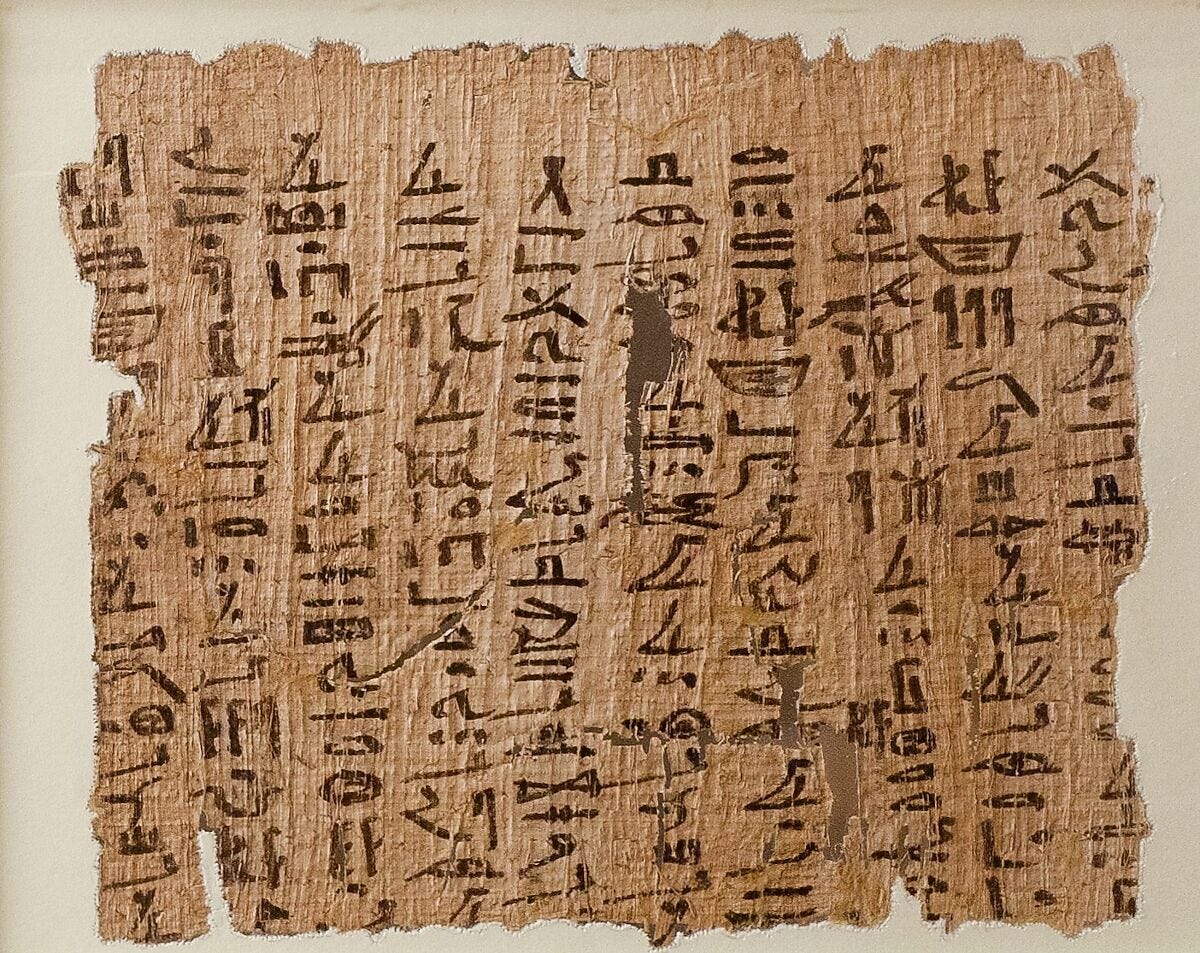
Thus walked we, amongst lily words and gilt phrases,
In the mornings I would teach her what God’s praise is:
Lord of plants, animals, Nature in her phases,
And man, like a god, the supreme.
- Percy Griffiths Smith, The Ruin of Florinda, 1851
Man is a fool if he thinks himself the ruler of the earth. Still, he is the only one who knows how small he really is.
- Musa ibn Isma’il al-Dawla, The Court of the Animals, ca. 1299
All fiction is an ironic commentary on God.
- Jean-Claude Clouzot, Le Beau Primitif, 1958
The man who must quote others,
Is in desperate need
Of a language
For himself.
- Lady Haru, Hisui no kakugen-shū: The Book of Jade Sayings, 1701
I. We Write to Dazzle Mark
The proudest I’ve ever felt in my life was in my freshman year of college, when a remarkably stoned friend named Mark—who had just come back up to my dorm room with my roommate—noticed a notebook of mine, lying halfway open on a desk, and suddenly became fascinated with it. “Whoa, man, this is really interesting handwriting, like, extremely interesting,” he said, bending down to read my scrawl. “What do you mean, interesting?” my roommate asked, sounding almost jealous as he did. “I don’t know,” said Mark, looking up with a big stoned smile, “it’s just interesting. Doesn’t look like any handwriting I’ve ever seen before. I just think it’s really interesting.”
They trekked off for dinner after that. I doubt Mark had time to discern one word. But the pride I felt in that moment has stayed with me ever since. Unknowingly, I’d stumbled into an ancient, hieratic scene: pure, primal hypnosis of the alphabet; Mark’s intoxicated brain suddenly shifting to the pure form of written language, in ways he might never have conceived before, rendered unintelligible by a stranger’s jumbled strokes, alienated from all he’d understood them to mean, reduced to their original charm (literally, as it used to be: a charm). I was watching my galactically-fried friend experience the same sheer fascination the first illiterate Greeks did, standing on the shore at Euboea, staring at nonsensical papyritic marks thrust into their faces by some grubby Phoenician merchant 3,000 years ago—he was dazzled, mesmerized, magnetized by the power of pure script. My script.
In that moment I understood, as I had never understood before, the really, the truly, the ridiculously simple reason why we write. Since he might be the most intoxicated man in the world, might not even care about the meaning of what he’s reading—but we all write to dazzle Mark. Out of a grand, stupid hope, we write so that someday a man like Mark will wander into our proverbial dorm-rooms, and in a stoned stupor, take one look at our most intimate handwritten nonsense, and pronounce it, at last: “interesting.”
But what about faith in God? Or Truth? What about belief in “the power of story,” myths and legends, narratives of grand adventures? Bull. The Phoenicians took their alphabet from the priests of Egypt, who refused to teach a couple vagrant businessmen the highest inner mysteries of their calendar and its picture-language. But the Phoenicians stole it anyways, never even bothered with the meanings, putting their own sounds to it instead; spurted out a syllabary, and then went romping up and down the Mediterranean, dazzling every slack-jawed Ionian and Carthaginian and Edomite with this hypnotizing new trick. Take just twenty-two little sound-symbols, fix them to your own tongue, and no more could the priests of Isis keep the secrets of written speech behind the veil. Writing was now to be had by any yokel stubborn enough to make his own edition: the Greeks gave theirs vowels; the Hebrews fit theirs to numbers and plumbed the secrets of IHVH. The Sign of the Bull became the Aleph became the Alpha became the A. Alors, anytime an anthropos avers an assumption about any auxiliary alphabetic aims, analogous assignations are automatically arrested. Amazement, astonishment, and awe are actual, authentic aims. All alternates are adolescent. Abracadabra.
II. We Write to Be Relevant
That is: to matter, in the scope of our era; to speak to the moment, to the world we find ourselves in. In the past, when some moldy writer sat down to write, they’d come up with songs and tales of the exploits of gods and demigods; they’d write about the adventures of a one-armed sailor, sold into slavery by pirates; about a princess freed from the curse of an old witch; about a young man of considerable promise but no wealth, discovering a great treasure; about a woman of considerable promise but no wealth, discovering a man. They would write of x x y y. They would write of y y z z.
Today, however, we must be relevant. So we mostly write about writing. Or else we write about how we’d like to write the way we used to, we just can’t, you see. There simply aren’t any gods or sailors or treasures or princesses left in the world. And besides, most of the people who read these days are writers anyways—so if you try to write about, say, an educated Venetian, captured by the Ottomans, who ends up the favorite of a pasha who loves astronomy, and all the other sciences, your audience (that is: readers who also want to write) will shrug, and your friends and your parents and your editors will shrug, and they’ll say: “Well we just don’t really know what to do with this. Isn’t it a bit old-fashioned? Couldn’t you just write…
A book about someone struggling to overcome a rare disease.
One of those fun stories about beautiful very rich people having slightly naughty sex with each other.
Better yet, why don’t you just write us another inspiring narrative about a young woman/man with bulimia/premature ejaculation, and a trust fund, who is taking a poetry course, and lives in the exotic land of New York? Oh how we would like that, yes, no more characters, no more histories or ridiculous implausible scenes; people simply don’t live like that anymore, you know? A trip to the deli store on ketamine has as much adventure in it as the Quixote, don’t you think? And it would surely be more relevant.”
“Come to us,” says the audience, “or we shall disavow thee.”
“Well, why don’t you come to me, for once?” says the writer.
Comes the response: “Because if we did, we know we would not like it. Shush now. We know exactly what we want, and that is what makes us an audience.”
III. We Write for That Special Class Called Agents
Writers get all kinds of wild notions into their heads. The least helpful of these is that their one true responsibility is to loudly and patronizingly remind whatever remnant of the reading public can still be reached of its own history. And this mostly means regaling it with the long story of its literature and literary forms, a history the majority of said reading public has already forgotten, or would like to forget. You see, the modern world is quite allergic to history, despite having all but invented it. This fact is perhaps just legible when one considers that of all times to ever call themselves modern, ours is the only one in which the name stuck. So, in our modern wisdom, we created a very special class with the express purpose of preventing writers from getting too carried away. These are called agents. Agents are elected by the people to help stop writers from fulfilling all those wild notions, rambling on and on, writing to the public about things like history and memory. Things which are very insulting to the public, who generally dislike being written to. To be fair, they’re quite sensible to disdain it, since the sudden perception that one is a member of a “public” is precisely what makes one immune to language.
IV. We Write to Give Critics Something to Do
The critic is a figment of the writer’s imagination, a device or conceit by which the writer proves they’ve written what they set out to write. Yet these figments have a disturbing tendency to manifest themselves in the real world. Piles and piles of critics keep appearing, for real; most of them end up waiting around idly, with very little to do. In this way, writers are the ultimate saving grace of society, because there’s nothing more dangerous to general human goodwill and the public interest, than the presence in its midst of a body of unpreoccupied critics.
V. We Write to Be Understood
The monk who would walk along the road, stopping to talk to a peasant working in the vineyards, could talk about heavenly spheres, or Aquinas, or the beauty of the Second Book of Samuel, and the peasant might smile and nod. But after the monk had gone, the peasant would say something like, “Bloody brother couldn’t just talk about the weather like everybody else? Impossible to have a conversation with, he is.” Then the rest of the workers would laugh, and agree how strange it was that the old monk cared so much for his books and dead scholars and silly stories, when the rest of the world hardly had time for such nonsense, busy as it was with the barer facts of existence—crops, kings, famines, plagues, wars, birthing and fucking and dying.
Can you conceive of a time, in the near future (if it hasn’t already arrived), when the average person might meet someone reading a book, and treat them just like the peasant would treat that monk—tolerant for a moment but mostly perplexed, by this alien scholar, retreating from the reality of the world for his unproductive solitude, poring over long, dense texts, full of things that probably never happened anyways? If you can, congratulations. You are a monk and you are living in the Middle Ages. You must write to be misunderstood—how else will you know what you say is true?
VI. We Write to Confuse Our Audience
At a pub in Westminster, I sat outside and read my book of poetry while I waited for a date to arrive. A few feet away, a drunk girl was trying to walk a straight line as her friends looked on, when an old grumbly man stepped out of the pub, directly into her path, too drunk himself to notice her. She had to stumble around him before he wandered off, never even acknowledging that she was there.
A minute later, an elderly man, in tattered clothes, with skinny, sharp legs came flying by, riding a bicycle covered in flashing neon lights and little flags. He was out of breath, exhausted, but still shouting, between puffs of air:
“Up the Patronage, up the disabled, out Labor, firing...(huff, wheeze)…firing squad!”
Then he cycled away.
VII. We Write to Please Ourselves
I hate myself. I hate myself. Why did I ever think I could write. What insanity ever convinced me I was capable of trying? Everything I do is shit. I AM shit. Everything I touch turns to shit. I am the King Midas of shit. I live on the top of Shit Mountain, and everyday I sling my buckets of shit out the window of my shitty Tower; but when I go back to my desk to write, I’m still never free of it—the shit. I hate myself, and everything I write, because both are shit. Where did I get the idea that anything I write would ever be worthwhile? How could I be so stupid as to think anyone would read what I write? I write poems, but they’re lousy. I write novels, but they go on and on and never say anything. I write plays, and every character is an idiot. I write essays, too, but all of them just end in the same place: I still don’t know why I’ve written them! Lord, help me. God, I’m praying to you. Help me make one thing I actually like. One thing that isn’t complete, total, actual shit. Christ, I hate this. Why do I do this to myself?
VIII. We Write
And I quote:
“Later, for some reason or other, he reminded me of one detail in my story; we must not allow ourselves to be led astray by the hopes of a one-armed Spanish slave! If we did, little by little, by writing those kinds of tales, by searching for the strange within ourselves, we, too, would become someone else, and God forbid, our readers would too. He did not even want to think about how terrible the world would be if men spoke always of themselves, of their own peculiarities, if their books and their stories were always about this.”
- Orhan Pamuk, The White Castle
Dear Sam, yes, this is indeed why we write! Thank you for writing, thank goodness for the readers (few) and the critics (legion), and for old books and our friends who are among the dead.
The Ruin of Florinda poem is beautiful